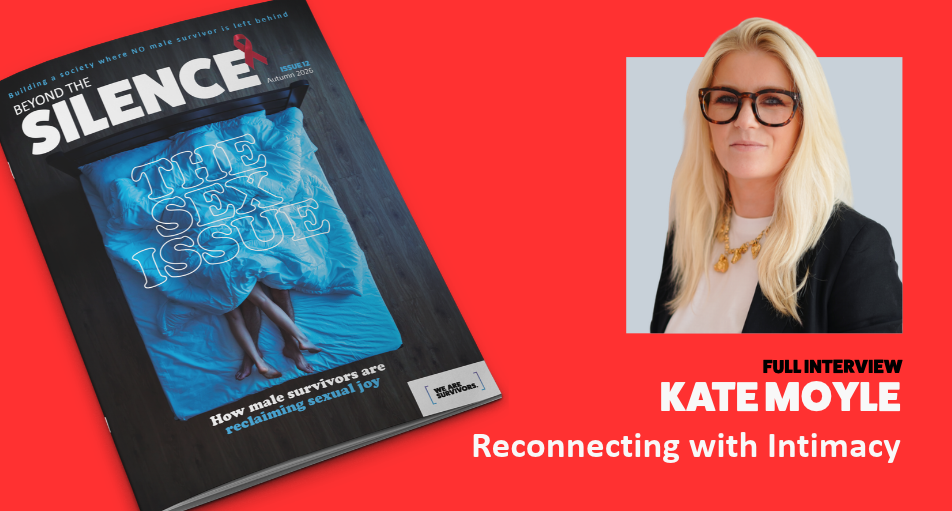
Kate Moyle is a UKCP-registered and COSRT-accredited psychosexual and relationship therapist, as well as a certified psycho-sexologist. She works with individuals and couples around sex, relationships and sexual wellbeing, and is known for helping to bring open, informed conversations about sex and intimacy to a wider audience. Kate is the author of The Science of Sex and host of The Sexual Wellness Sessions podcast.
In this interview, which appears in edited form in Beyond The Silence, Issue 12, Kate explores how sexual harm can affect male survivors’ relationships with their bodies, desire and intimacy. She discusses the importance of choice, safety and connection, and how male survivors can begin to find their own ways back to pleasure and fulfilling relationships.
How can sexual harm affect a person’s relationship with their body, desire, and intimacy?
Sexual harms can change the relationship that we have with our bodies, desire and touch, and the ways in which we relate to and see ourselves, all of which can feel even more exposing when it comes to sex and intimacy. Sexual harms are rooted in a violation of the body, trust, and our sense of personal control – and once we have experienced it, we can’t un-know that it’s possible.
This doesn’t mean that it can’t be worked on or redeveloped, but we will need to develop and re-establish a sense of choice, safety and connection with ourselves in order to then allow ourselves to be that way with a partner.
How an individual is affected doesn’t look one way, and may be expressed in an unlimited range of behaviours. Some may look like a shut-down of the sexual self and complete avoidance as a way of coping, and others may involve seeking out more sexual experiences, or engaging in more intense or high-risk sexual behaviours. Any behaviours can be exhibited – but they may not be a true reflection of how exactly someone is feeling, but more ways of coping with sexuality which at one point felt unsafe.
What are some common ways sexual trauma can show up in men’s intimate lives years after the abuse or assault?
Ultimately, it can show up in any number of ways, some of which may not immediately or obviously relate to sex. There are huge amounts of shame attached to experiences of sexual harms, and we may be able to find ways of coping with and managing these feelings outside of sex. Those coping mechanisms are often less available, or not available at all, when it comes to sex and intimacy, which can make it so hard to navigate.
In terms of what we see as psychosexual therapists, someone may present as having little to no interest in, or response to, sex, either in terms of desire or arousal. They may struggle with difficulties such as erectile dysfunction, being present during sex and experiencing pleasure, or being able to achieve orgasm.
Many report feeling disconnected during sex and intimacy, and may avoid it altogether. Some seek out intense or high-risk sexual behaviours, or sexual behaviours can feel as though they become compulsive. Sexual responses can also feel disorganised: they may be present with a coupled or intimate partner, but not with a non-emotionally connected partner, or when they are on their own.
Sexuality confusion and questioning may also be present as someone tries to understand themselves and what happened in the context of their sexuality. What’s key to consider is that there aren’t fixed ways that people can be, and there are factors outside of the experience of sexual harms, assault and abuse which can also have an impact, such as whether they were able to seek help, were believed, or had previous experiences of harm, assault or abuse.
How can survivors distinguish between trauma responses and their authentic sexual desires?
It’s such a complicated and almost impossible distinction to make, precisely because the two can become so tangled, and what previously may have been a desire, a safe place or a wanting may have changed in nature due to the trauma someone has been through.
Ultimately, it’s about the sense of safety and autonomy someone feels and has over the experience that they are having, and knowing that they can say no or change it at any time. Triggers can also catch us off guard – some are more obvious and known, and others are not.
If behaviours are feeling self-shaming or highly activating for you, and you are left with the emotional consequences of that, it’s likely that this needs exploring, perhaps with a safe person like a trauma-informed professional.
How can survivors begin reconnecting with pleasure when pleasure itself may feel frightening or triggering?
Pleasure begins with noticing what feels good in your own body, and this is a process that you need to begin on your own before bringing in anyone else. Our sexual experiences are rooted in sensuality, and so for someone who has experienced sexual touch as unsafe, it’s important to very gently re-engage with your own body in a way which helps you to establish a sense of safety, with choice and control and no agenda or expectations.
Your brain’s priority is to keep you safe, and so if or when you are feeling activated by touch or sensation, there is work to be done in terms of psychologically separating out touch which is intended to be harmful from that which isn’t. This is a process that can take time, as we try to re-establish and re-learn.
The added challenge to this is that it so often feels that the hardest work and recovery has to be done by the victim of harm, rather than the perpetrator, and that brings such an added layer of emotional and psychological complexity.
Is reclaiming sexual joy always about sex, or can it begin with other forms of connection and self-awareness?
Absolutely, and I think that taking sex down from its pedestal can be very helpful in these experiences. The shame carried by many victims of sexual harms, assault or abuse can create a barrier between them and connecting with others or truly being seen.
The irony of feeling shame is that it can encourage you to isolate and disconnect, but these safe connections can help us to challenge and break down shame. Intimacy is not dependent on sex, and vice versa – but intimacy may also have been abused as a part of sexual harms, and this can bring layers of confusion about where intimacy can start to feel safe, as we have to take the emotional and psychological risk to feel close to someone again.
How can partners best support male survivors who are navigating intimacy after trauma?
In terms of what a partner can do on their own terms, educating themselves can be a really good place to start, so that they can feel they have a clearer understanding of some of what may be going on for their partner. Understanding that responses to feeling triggered or activated can be mistaken for rejection, lack of desire or emotional confusion in relationships – and someone may not always have the words to describe what is going on for them, particularly if they are in a trauma response.
Communication is key, but often not easy. If possible, it can be useful to discuss things at a time when you’re definitely not going to have sex. Agree on questions between you, such as ‘what would make you feel safer right now?’ rather than something like ‘what’s wrong?’
What someone wants may not always be consistent – sometimes it may be space or a break from touch; other times, it may be to maintain contact but to slow things down or stop. Permission for sexual experiences to stop or change course is important to have established. And don’t feel afraid to seek support for yourself too if you feel you need it.
How can survivors manage the fear of vulnerability that often comes with intimate relationships?
Know that it’s inevitable and a part of feeling human, and a part of intimacy. In a way, being in an intimate relationship always comes with some risk of being hurt, but there is a clear difference between that and abuse.
Vulnerability will not always feel comfortable, and it’s about learning how we experience the role of choice and freedom for ourselves within intimacy – this is the thing that sexual harms can rupture and take away from us. It’s ultimately about us being able to trust ourselves so that every decision isn’t governed by fear and/or shame.
In your work, what approaches have you found most effective in helping survivors reconnect with pleasure and intimacy?
Rather than one approach, it’s a framework that we discuss as biopsychosocial – understanding the different physical, psychological and social elements, and the constant and inter-related relationships between all of these elements in someone’s life. Every survivor will need something different, and that’s because we are all different and have different layers of life experiences and contexts.
Psychosexual therapy is about understanding what someone wants to change, how they see themselves and how they want to feel, and what’s getting in the way of that being possible for them. It’s a combination of the therapeutic relationship, psycho-education and helping someone to get to where they want to go – all at a pace that they need.
What would you say to a male survivor who believes they will never have a fulfilling intimate life?
That you are not defined by what happened to you and what you have been through. Your life may have been altered by and shaped in some way by it, but there are so many other things that make you valuable as a person. Sexuality is flexible, and a fulfilling sexual and/or intimate life does not only look one way, or have to be one thing.
What gives you the most hope when working with survivors?
Moving people from a place of ‘what’s wrong with me’ to ‘what happened to me’, and from there we can start to shape ‘what do I need right now’. We also have to recognise that ‘right now’ isn’t a fixed or static entity, and that recovery and growth can also take place in relationship with others. These relationships may bring up challenges for us, but we are not deserving of less because of what we have been through.
I so often hear people describe themselves as ‘broken’, and one of the big challenges is that people are not things to be ‘fixed’. Working through what happened and how it has impacted your life is a process. It can take time and it can be incredibly hard, but it’s possible.
When a male survivor has reclaimed sexual joy, how does that show up in their life?
For male survivors, there is such a huge process of working with what happened to them in the context of so many messages about masculinity and ‘shoulds’. I believe that reclaiming is recognising that and starting to break free of it.
Ultimately, sexual joy isn’t about the act of sex alone – it’s about your relationship to your own sexuality. It’s about sex belonging to you, rather than being defined by what happened to you and someone else’s actions. It’s about learning to be comfortable and happy in your own body, and giving yourself grace, permission and what you need when you notice when you’re not.
It’s about our relationship with ourselves, and how we allow ourselves to be in relationship with others – and that shows up in every part of our lives, not just sex.
Listen to Kate’s regular podcast ‘The Sexual Wellness Sessions’