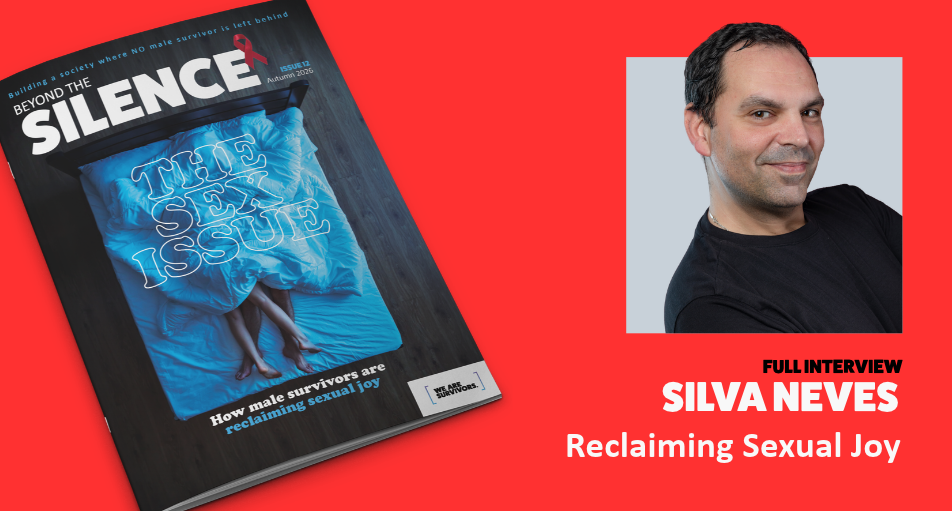
In this interview – which appears in edited form in Issue 12 of our quarterly magazine Beyond The Silence – we speak with Silva Neves, an award-winning, UKCP-registered and COSRT-accredited psychosexual and relationship psychotherapist, and trauma psychotherapist who specialises in supporting survivors of sexual abuse. Silva also works extensively with LGBTQ+ communities and has particular expertise in sexual trauma, relationships, intimacy and sexuality. He is a clinical associate of Pink Therapy, an international trainer and a published author of books on sexology and compulsive sexual behaviours.
Drawing on his clinical experience, Silva explores how sexual trauma can affect our relationships with our bodies, desire and pleasure, and how male survivors can begin to rebuild intimacy on their own terms. He also discusses the importance of patience, self-compassion and supportive relationships in the journey towards recovery.
How can sexual harm affect a person’s relationship with their body, desire and intimacy?
A lot of people can develop post-traumatic stress symptoms, and the common ones can be dissociation, which means that the body becomes numb to a lot of sensory effects. It becomes numb to emotions and can even become numb to touch. Which means that if someone gets touched, they might not feel any pleasure, they might not feel any sensation, which can mean not a very good sex life. Sometimes dissociation can also be linked to emotion, so people might not feel anger for example, but also they also won’t feel horny either. Everything gets muted, which can be an issue.
Trauma also impacts on the nervous system. Which could mean that people can become hyper-vigilant, and very jumpy. Often with male survivors of sexual abuse, they’ll become quite jumpy with people in close proximity to them. It could be a hand – or another part of the body – that comes in close proximity to parts of their body that were wounded or harmed, or an area of the body that is associated with the trauma.
There are also flashbacks, which are quite common as well. This could be seeing things that are not there, but it’s because it’s tied to a memory that can be triggered unsolicited. Some people may see their abuser’s face instead of the face of their partner; which is obviously very, very distressing. Some people have a smell that’s associated with past abuse, or a touch that’s associated with the past abuse. Some people can hear things as well. All of this makes people avoid any situations that can remind them of any sexual activities.
What are some of the common ways sexual trauma can show up in men’s intimate lives years after the sexual harm?
It can be random. Sometimes people get symptoms straight away, and other times the symptoms are dormant for years and years until there is something that – and sometimes people don’t know what it might be – reminds them of the trauma.
So, for example, they can just be walking around, and if they see red trainers, and their abusers happened to wear red trainers 15 years ago, that can start to trigger a series of memories, which can trigger post-traumatic stress symptoms.
For other people, sexual trauma can show up pretty much straight away. What we tend to say is that if there are any trauma symptoms in the first six months after trauma, to see how that settles without any interventions. Because sometimes after six months, it settles and people can start to have some kind of normal life. So, we’ll often wait for six months, after 6 months before we begin to formulate any post-traumatic disorder and offer treatment.
How can survivors distinguish between trauma responses and their authentic sexual desires? Is there often a confusion that their trauma response IS their authentic self?
Absolutely, yes. Some people often say “it’s part of my DNA, it’s who I am.” So, they very much identify with that reaction, because there’s not a lot of sex education, actually. A lot of people aren’t even sure if what they are feeling is normal or not. So, someone who has dissociation and are having no sexual desire might be saying, “it’s just who I am.” And sometimes it can be who they are, because some people are asexual. Asexuality is a genuine sexual orientation. But for some, it could be that they’re just avoiding relationships, and avoiding sex because of the trauma, and they’re telling themselves that’s who they are.
How can a survivor begin the process of reconnecting with pleasure, when pleasure itself may be frightening or triggering?
Well, I think first, they have to figure out if it’s something that they want to do, because not wanting to have sex is okay. Sex doesn’t have to be something that people do, but often people feel pressured to have sex and to have it a certain number of times a week to feel like men, or to feel like they’re not broken in some ways. But actually, some people can live without sex, perfectly, happily. Some people can live with having sex once a year, perfectly fine. So, the first conversation is, why do you want to have sex? Do you want to have sex? Does not having sex cause a lot of distress in your life? Or are you wanting this because society or your peers tell you that you should? I think that’s an important starting point.
Then after that, it’s just about gradually getting to know their erotic mind. So, it could be experimenting to start with. Is there anything that you can think of that can bring some titillation, maybe, or some interests that are erotic or even sensual? Sometimes people can think “I really like when I see somebody in high heels”, for example. And other times, people will be like, “I just have no idea.” It could be when you watch TV, for example, and your eyes are drawn to things? Occasionally, if you go on a beach, where people have like bikinis and swimsuits – do your eyes go to places? Just pay attention to that.
I would ask people to pay attention to their sensations and their sense of pleasure that is non-sexual as well. Because the dissociation can also affect that. When we work on one area of pleasure, then another area of pleasure can get better. I would say, do you have any kind of favourite food or favourite dessert? Do you enjoy it when you actually eat your food? I would ask him to pay attention to those things. It could be like the pleasures of a favourite scent, like maybe essential oil, or a favourite fabric to touch, like cotton, silk… these kinds of things.
It’s not always about sex, is it? Can reclaiming sexual joy begin with other forms of connection or self-awareness?
Absolutely, yes. Something that I often see in my clinic that is missing, is a sense of fun. Obviously, sex is supposed to be fun, but often people don’t have a sense of fun outside of the bedroom, either. So, even sometimes asking people to pay attention to how much they have fun. Are they always serious with their partners, if they have a partner? Can they make jokes? Can they love? Can they have light conversations? And for some people, with history of trauma, sometimes they can find it hard to feel a bit of lightness.
How can partners best support male survivors who are navigating intimacy after trauma?
They need to be willing to be patient and also willing to experiment. When the person with a history of trauma feels ready, that might mean trying something gentle, such as a massage rather than sex, and simply seeing how a little touch feels. It could also mean sharing a favourite meal, laughing together, or doing something light-hearted, such as watching comedy.
Patience is essential because recovery can be a long road, so partners need to ask themselves whether they love the person enough to walk that road with them. That can be a real act of love. At the same time, partners should not ignore their own needs, because they have needs too. So, I always think that for people who support people with sexual trauma, they should also have their own therapy or their own support outside of it as well, so that they can make sense of things for themselves too. Otherwise, they can feel alone, otherwise they can feel alone, and holding the whole situation, and I don’t think it’s very good either.
In your work with survivors, how important is it that the partner – if there is a partner – is part of the counselling and support process?
It is important. If somebody says to me in the initial session, or even in the e-mail enquiry, that they’ve had a history of sexual abuse, and want to work on their sex life, and they say they have a partner, my first suggestion will be to bring the partner over.
For two reasons really. First, because having your partner needs to be involved means that person doesn’t feel broken. Often if someone wants to come individually, they often believe that they are the broken one that needs to be fixed. But the partner needs to be involved too, because they are part of the relationship as well. Then it feels like the survivors can start to reframe where the distress is. It’s not just in the brokenness of one person.
So what can the impact be on a partner? How do you see it manifesting in the partners of survivors?
Sometimes a partner can be exasperated; they can be exhausted; and they can be frustrated, because they might just be thinking, “you know, I do want a sex life too, and I’m not really having the sex life I want.” And so, it’s really encouraging them to stay empathic, but also encouraging them to meet the sexual needs in other ways.
And so, if they are in a monogamous relationship, typically, I would recommend that they purchase a really good sex toy, and that they are really accessing sexual pleasure in that way. Until things get resolved with their partner.
For any male survivor reading this who is just starting to contemplate starting a journey of recovery, what immediate advice would you give to them?
One thing I’d say is that their partners don’t need to know everything about their sexual abuse. Sometimes it can be difficult for someone who has a history of sexual abuse to tell the whole story. And sometimes telling the whole story can be re-traumatising.
All they need to know – to start with anyway – is where to touch and where not to touch. Basically, how to approach a person or, you know, whether to invite them for sex or not.
And for the person with the history of sexual trauma, I would say that the best way to begin the journey is not to be goal-oriented. So not to say – for example – I want to have the best erection in three months’ time. The best sex that any of us has is the sex that’s not goal-oriented. It’s the one that is focused on pleasure and fun, not the one focused on “I must have an erection in order to penetrate.” It’s for that reason that I say at the beginning of therapy “we’re not going to be penis-oriented here.” The goal is not for to have erections all the time because when the nervous system is impacted by sexual trauma, that’s going to affect erections. But it doesn’t mean they can’t have any kind of sexual or erotic or sense of pleasure without erections. In fact, there are lots of different parts of their body that can be erogenous which are important to consider as well.
We’ve spoken a little about survivors who may be in relationships, but for those survivors who are not in relationships, is the journey to reconnect with intimate joy a similar path?
It’s a similar path in terms of not being goal-oriented, but it can be different depending on if they are desperate to have a relationship, or they believe they can’t have a relationship because of their sexual trauma; or if they’re actually quite happy to be single, and experiment with different people.
In some ways, if they’re single and they’re quite happy to experiment with masturbation, for example, or experimenting with dating, then that can offer a bit more choice because they’re only experimenting with one person. But, in some ways, it can also be riskier and more stressful because meeting someone new is inherently anxiety-provoking. And so, for people with a history of sexual trauma, it can be doubly anxiety-provoking to meet someone new. But at the same time, this is when they can begin to experiment with setting their boundaries with a new person – even before they meet, like on text or something. They can say, “For me, this is what I need, this is what I’m not, this must not happen.” Experimenting with the boundaries around their bodies and around sexual activities. So, you know, it can be similar in some ways, but also different.
In your work, what approaches have you found most effective in helping survivors reconnect with pleasure and intimacy?
It really depends on the individual, but there are so many ways that you can look at pleasure and joy because it’s just so diverse, isn’t it? For example, like this past summer, it was a very sunny and hot summer, and so for a lot of my clients, I said, “pay attention to what it’s like to feel the sun on your skin.” Or if some people go on holiday, it will be “pay attention to what it’s like to have your feet in the water or just hearing the waves of the ocean.”
Anything that’s sensory that you can just enjoy that moment without thinking or overthinking or putting a story onto something. Often people with trauma, when they experience something nice, will have a voice or a thought that says, “oh, but it’s going to stop”, or “that’s going to be taken away from me”, or, “it’s not good enough, I’m not deserving of this.” Those kinds of critical thoughts.
So really, the first thing would be how to help people experiment with a sense of joy, a sense of pleasure. Unapologetically trying to shut down those voices. It can be hard. I’ve said to my clients, “You don’t have to get it right to start with.” It’s just like the gym. At the beginning, it’s hard. So those automatic thoughts will come, but it’s about catching them and transforming them into different thoughts. It also comes with repetition, and the more you get used to doing it, the easier it gets.
The mind is so interesting. If someone is getting really good at feeling joy or pleasure in any activities – and that could be singing, dancing, playing golf, whatever – then it can actually be much easier for them to access sexual joy and sexual pleasure, because it’s all part of the same network in some ways. It’s all about our sensory self.
Other times, what could work is different philosophies of life. So, for example, I sometimes say to people “Life is short. What are you going to do today? You’re alive on this planet today. What are you going to do about this? Are you going to look at the past or are you going to be in the moment?”
Sometimes people really connect with that… paying attention to the fact that they could be wasting so much of their time alive in trauma. Sometimes for people, they just need to be with other people. It could be about finding the good people that they need to have around them. And after sexual trauma, those people might be very different from the friendships they’ve had before trauma.
Often, I hear my clients say their circle of friends is a group of lads, where they just talk about sexual progress. They talk about conquering women, about dating, and about being great in bed. Often that really shuts down the conversation for that person because they think, “Oh gosh, I’ve got to pretend I’m like them.” And they feel bad about themselves because they actually believe other people’s stories when, of course, often other people’s stories are lies. Sometimes I say it’s good to have two or three people, or you can just properly relax around, when you don’t have to perform masculinity, or pretend you’re someone you’re not.
It’s interesting that you’ve mentioned a couple of times in this recovery process not to be too goal-focused. I guess if you are trying to reconnect with your intimate life and your sexuality again, you may try things that might not work. Is that when it’s important to not let that become a barrier and to keep going? Maybe even have a bit of fun if it doesn’t work?
Yes, and that’s why I use the word ‘experiment’ because experimenting means that sometimes we figure out, “oh, that was not for me.”
I usually give the analogy of food because we tend to be more socially conditioned to talk about food than we are to talk about sex. If you visit a restaurant, you’ve never tried before, and you look at the menu and choose something that you don’t even know the name of. You might end up hating it. What are you going to think about this? Are you going to think “I’m never going to go to another restaurant ever again?” Or do you think, “I’ll just go to another restaurant next time.”
It’s the same thing with sex. It’s experimenting. If it doesn’t work, if you don’t like it, no problem. It’s information. It’s learning. And that’s valuable.
For any male survivor reading this who believes that they’ll never have a fulfilling, intimate life again, what would you say to them?
We just don’t know in the future, we just don’t know. But what is quite likely is that they’ll find a way to have some kind of pleasure and fun in their lives if they actively keep at it.
All of us can sometimes spend weeks bogged down by the demands of life and not spend a moment of pleasure, right? And so, it’s for all of us to be attuned to that. And if we are attuned to that, it will come. But we must work at it. It won’t happen by itself. I’ve got the privilege of seeing so many people, and I’ve seen some people finding the right partner and having the best sex life of their lives in the 60s and even 70s.
When a male survivor does find that place where they can reclaim sexual joy, how does that show up in their lives? How does it improve their lives?
I think that they begin to feel in their bodies, in their mind, a bit more lightness. Sometimes people say, “oh, it feels like I’ve got a spring in my step now.” Or sometimes it could be, “I’ve managed to sit down, and my mind was quiet for a little bit. It’s a long time since I’ve been quiet.” Or sometimes feeling calm in their bodies.
It’s those small moments that are important. We’re not looking at the big grandiose life-transforming things. When people start to be more pleasure focused and joy focused on their lives as a philosophy of life, life really does transform. Not in the way of “I’ve got the perfect sex life”, but in the way of feeling like, “Okay, I’m good.” Happiness is a moment that comes and goes. It’s more about contentment. Contentment is the hum in your life… that contentment hum. It doesn’t mean that you don’t have ups and downs. It doesn’t mean that you don’t have bad days, but it’s just that sense of being grounded.
As a professional in this field, what gives you the most hope when you’re working with survivors?
Well, it’s so rewarding, isn’t it? In my position, working with male survivors of sexual abuse, I can see it before my eyes… people just really changing.
I see when they start to recover, they feel it in their bodies, they feel lighter. I see more spark in the eyes, and that’s just something so beautiful to see. When people first come to therapy, they might feel very heavy, and might not even be able to make eye contact with me. Then, towards the end, I can see that spark, and lightness in their bodies. It’s so, so rewarding to see that kind of transformation. But it doesn’t happen straight away. Sometimes it takes quite a few years.
I also enjoy the consistency of meeting them week after week, getting to know them, having that special therapeutic space that is a unique relationship. We don’t get that kind of relationship elsewhere. It’s just a beautiful, beautiful space to be in. And I know that when somebody recovers, it helps their partners too. It helps them have better relationships, and that might help them be better parents, and their children will be able to get on with life. There’s a ripple effect that we don’t see, but we know in theory happens. And that’s wonderful, because unresolved trauma often creates more trauma. So, to have this opportunity to help one person, can help even more people.
Finally, is there anything you really want to say to any male survivors reading this?
Often, with people with trauma, especially if it’s happened in childhood or before sexual development, they might say, “Oh, I’m gay because I was abused by a man”, or “I’ve got a kink, but maybe I’ve got a kink because of my trauma.”
I think it’s really important, not just in therapy, but actually in terms of knowledge, to really reinforce the message that sexual orientations are not trauma-based; and that people can be kinky; they can be polyamorous; they can have all sorts of sexual interests that are not trauma-based. We know that from research. Sometimes there’s some overlap between kink and trauma. Sometimes people come to therapy and say, “I’ve got a submission kink because I was abused, and I want to treat my sexual abuse, to eradicate my kink.” My response is always “No, we’re not going to do that because that’s a form of conversion therapy.”
We would like to extend our sincere thanks to Silva for giving his time and sharing his considerable knowledge and expertise with us, helping to open up an important conversation about sexual trauma, healing and the possibility of male survivors reclaiming sexual joy and intimacy.