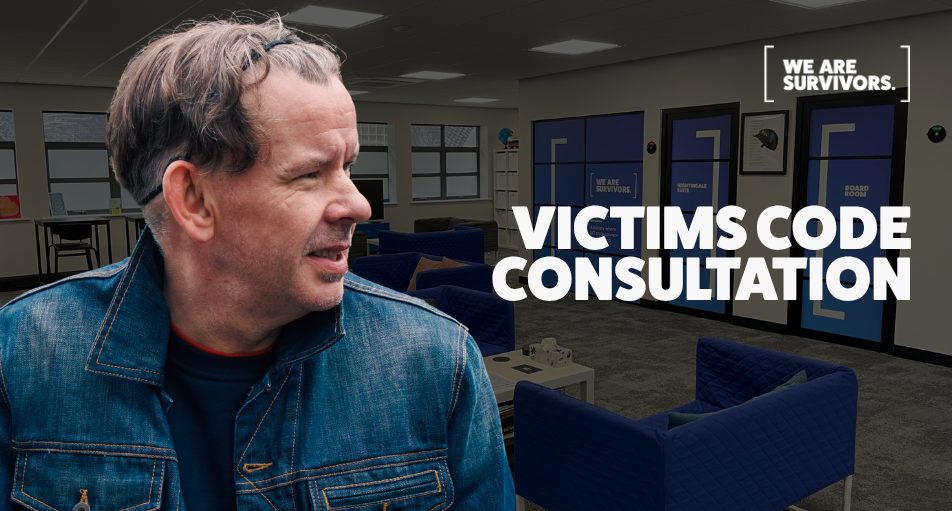
Last month, as part of a Ministry of Justice consultation on a new draft of the Victims Code, We Are Survivors spoke to members of our survivor community, our Expert Reference Group, and the loved ones of survivors
The Victims Code is effectively a ‘bill of rights’ for anyone that has been a victim of crime.
A victim is classed as anyone ‘who has suffered harm, including physical, mental or emotional harm or economic loss’ by way of a criminal offence – this also applies to parents or guardians to victims under the age of 18.
The Code contains twelve rights that are meant to be made known to victims at the point they report to the police and throughout the criminal justice process. In the words of our ISVAs, the code applies ‘from report to court’.
However, male victims/survivors of sexual harms are affected by their abuse long after disclosing and the report to court process. We know that men spend decades in silence before disclosing to anyone, let alone acquiring the confidence to approach the police with this information. Sadly, it can then be a postcode lottery for support during and after the criminal justice process, a process which itself can be drawn out over the course of years due to the court backlog.
Shockingly, the Crime Survey for England and Wales states that only 18% of victims know about the code.
That is why We Are Survivors are determined to amplify survivor respondent’s voices in calling for better awareness raising around the Victims Code. We are clear that it should be on victim’s radar before they disclose to the police. We want to see it placed on noticeboards for anyone to read, in GPs, Churches, Gyms, Community Centres, et cetera.
The people that fed into the consultation also shared their thoughts on Victim Impact Statements (previously known as Victim Personal Statements). A Victim Impact Statement is designed to give victims the chance to write up how what happened to them has impacted them , with the purpose of it being it to be read out by a judge at sentencing, or by officials at a parole hearing.
It’s great that the new code states that victims should have more chances to update their statement, particularly as criminal justice proceedings today go from months to years. But the problem remains that a Victim Impact Statement is only seen as having importance at the point of the accused being found guilty, whereas the impact of the victim/survivors experience holds importance in its own right.
Of course, the survivors that use our services, our Expert-Reference-Group members, and the loved ones had loads more to say which all formed part of our response to the Ministry of Justice. We also shared what was said with the Victims Commissioner for England and Wales, Claire Waxman OBE, as she developed her response and Claire even came up to meet with some of our lads.
We aim to do much more with the Victims Commissioner to raise awareness of the Victims Code, ensuring that the Police and Criminal Prosecution Service keep victims informed of the Code, and making sure that no male survivor is left behind.
We’re always so grateful to everyone who tells us what they think, because that is how we learn and grow.
For more information on the Victims Code
For mor information on the Victims Commissioner